KK Mart IPO (KKMART 5360): Malaysia's Largest Convenience Chain of 1,106 Stores at RM0.55 - NOT Shariah Compliant

⚠️ WARNING: This IPO Is NOT Shariah Compliant
The KK Mart prospectus does not state any Shariah-compliant classification by the Shariah Advisory Council of the Securities Commission (SC). KK Mart sells tobacco products (27.1% of FYE2026 store revenue) and liquor. Muslim investors who follow Shariah-compliant investing are advised to avoid this IPO. This article is for information only.
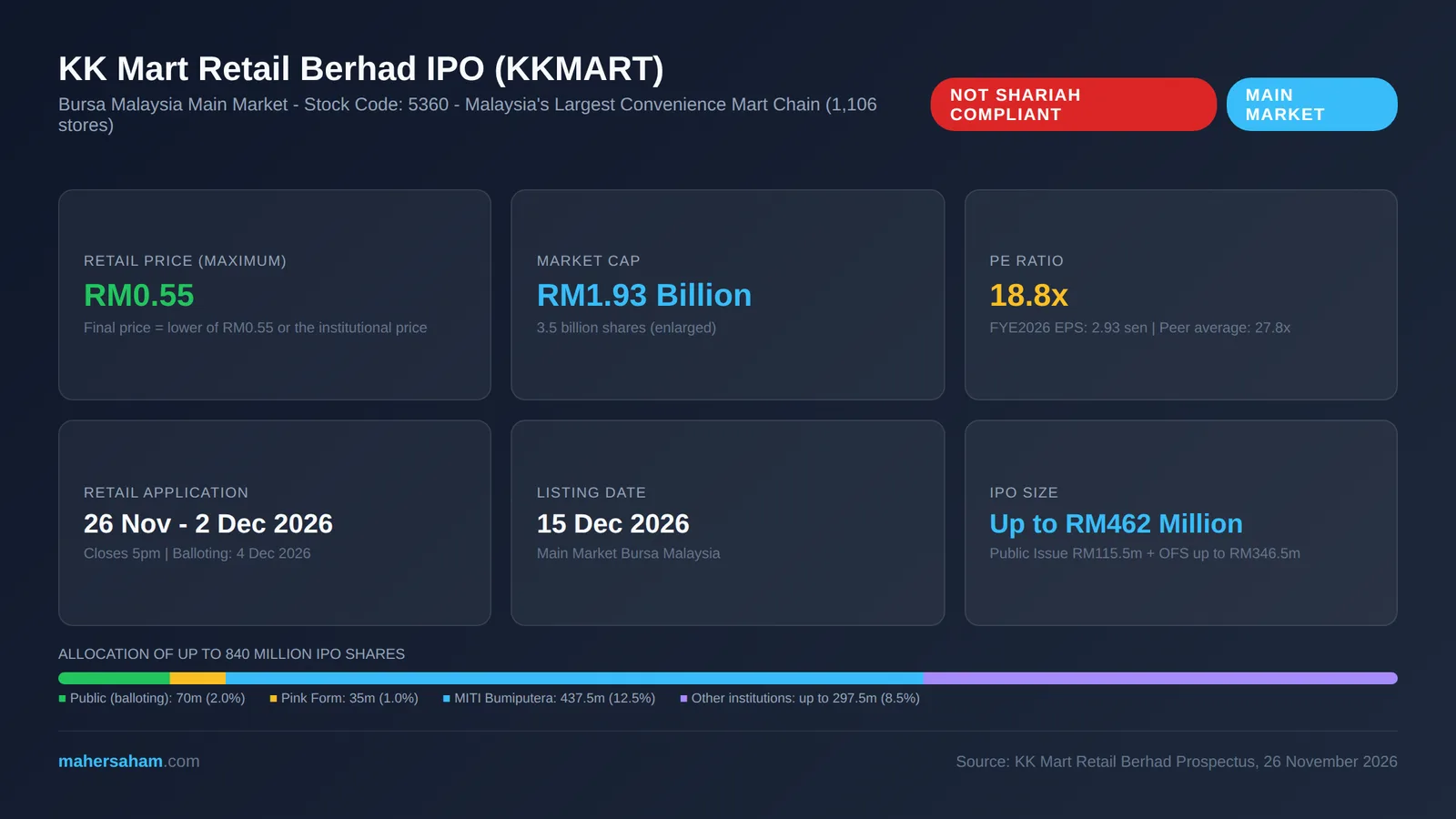
KK Mart Retail Berhad (KKMART, code 5360), the company behind the 24-hour KK Super Mart convenience chain, opened its IPO for applications on 26 November 2026 at a maximum retail price of RM0.55 per share. It is scheduled to list on the Main Market of Bursa Malaysia on 15 December 2026. At the retail price, its market capitalisation is about RM1.93 billion.
With 1,106 stores across the Federal Territories and nine states, KK Mart is Malaysia's largest convenience mart operator by store count. Revenue keeps rising every year, but net profit has barely moved over the last three years. This article summarises the key facts from the official prospectus dated 26 November 2026: offer details, share allocation, use of proceeds, financial performance, valuation against peers, past incidents and the risks you should understand.
Quick summary: Maximum retail price RM0.55 | Market cap RM1.93 billion | PE 18.8x (FYE2026) | NOT Shariah compliant | Applications close 5pm, 2 December 2026 | Balloting 4 December | Listing 15 December 2026. See full IPO data →
Who Is KK Mart Retail Berhad?
KK Mart's story began in 2001 when Datuk Seri Chai Kee Kan and his siblings opened the first store in Kuchai Lama, Kuala Lumpur, as a sole proprietorship. The operating company, KK Supermart & Superstore Sdn Bhd, was incorporated in 2003. The listing vehicle was incorporated on 27 September 2023 as KK Supergold Sdn Bhd, renamed KK Mart Retail in February 2025, and converted into a public company in March 2026.
Today Datuk Seri Chai is the Group Managing Director, while the Chairman is Tan Sri Abd Rahman Bin Mamat, an independent non-executive director.
1,106 stores, almost all open 24 hours
As at the latest practicable date (LPD) in the prospectus, KK Mart operates 1,106 stores. Only eight stores do not run 24 hours, because they sit inside buildings such as universities, shopping malls or transport hubs. The network is concentrated in the central region:
- Central (Selangor, Kuala Lumpur, Putrajaya): 746 stores (67.5%)
- Southern (Johor, Melaka, Negeri Sembilan): 237 stores (21.4%)
- Northern (Perak, Pulau Pinang, Kedah): 83 stores
- East Coast (Pahang): 30 stores
- East Malaysia (Sarawak): 10 stores
Growth has been fast. Store count rose from 777 (June 2024) to 890 (June 2025), 1,042 (June 2026) and 1,106 at the LPD. The company targets more than 1,500 stores by June 2028, averaging 20 new stores a month in FYE2027 and 24 a month in FYE2028. It also plans to enter Terengganu, Perlis, Kelantan and Sabah by June 2027.
Beyond physical stores, KK Mart sells through its own website as well as GrabMart, ShopeeFood and Foodpanda. It has 182 house-brand products, the KK Rewards app, and the KK Concept Store format selling ready-to-eat meals.
Industry position
According to the independent market research (IMR) report by Frost & Sullivan in the prospectus, KK Mart leads the convenience mart segment by store count and 2025 revenue, with a 77.6% share of that segment. Measured against the wider group of all convenience retailers in Malaysia (including chains such as 7-Eleven), its market share is 14.9% by revenue. The convenience mart segment grew from RM0.8 billion (2020) to RM2.2 billion (2025) and is projected to reach RM4.9 billion by 2030.
KK Mart IPO Details
| Item | Details |
|---|---|
| Market | Main Market, Bursa Malaysia |
| Stock code / name | 5360 / KKMART |
| Retail price | RM0.55 (maximum, payable in full on application) |
| IPO size | Up to 840 million shares (24.0% of enlarged shares) |
| Public issue (new shares) | 210 million shares, gross proceeds RM115.5 million to the company |
| Offer for sale (OFS) | Up to 630 million existing shares (18.0%), up to RM346.5 million to selling shareholders |
| Shares after IPO | 3.5 billion shares |
| Market cap at retail price | RM1,925 million |
| Principal Adviser, Bookrunner, Underwriter | Maybank Investment Bank Berhad |
| Issuing house | AscendServ Capital Markets Services Sdn Bhd |
Important about the price: RM0.55 is the maximum price. The final retail price is the lower of RM0.55 or the institutional price set through bookbuilding on 4 December 2026. If the final price is lower, the difference will be refunded to successful applicants.
The company's draft prospectus was earlier posted on the SC prospectus exposure page before it received SC approval on 22 September 2026 and Bursa approval on 26 October 2026. The retail underwriting agreement with Maybank IB was signed in mid-November, as reported by The Star.
Key Application Dates
| Event | Date |
|---|---|
| Retail offering opens | 10.00am, 26 November 2026 |
| Retail offering closes | 5.00pm, 2 December 2026 |
| Price determination and balloting | 4 December 2026 |
| Allotment to successful applicants | 14 December 2026 |
| Listing on the Main Market | 15 December 2026 |
For the steps to apply through an online trading account, see how to apply for a Bursa IPO with MPlus Global (in Malay). After balloting, you can check your result with our guide on how to read IPO balloting results.
Share Allocation: Only 3% for Retail
Most IPO shares go to institutions. Retail investors get only 105 million shares, equal to 3.0% of the enlarged share capital:
- Malaysian public via balloting: 70 million shares (2.0%), half of which (35 million) are for Bumiputera
- Eligible persons (pink form): 35 million shares (1.0%) for directors, employees and persons who contributed to the group's success
- MITI-approved Bumiputera investors: 437.5 million shares (12.5%)
- Institutional and selected investors: up to 297.5 million shares (8.5%)
There is also an over-allotment option of up to 70 million shares borrowed from K8 Resources, for price stabilisation after listing.
Use of Proceeds: Only RM115.5 Million Goes to the Company
This is a point many investors miss. Of the up to 840 million IPO shares, 630 million are an Offer for Sale by existing shareholders, namely K8 Resources (542.5 million shares) and Arus Sejahtera (87.5 million shares). The proceeds from these shares, up to about RM346.5 million, go to them, not to KK Mart. If the difference between the two types of offer is new to you, read the difference between Public Issue, Offer For Sale and Private Placement in an IPO.
Only the public issue of 210 million new shares brings money into the company, which is RM115.5 million at RM0.55. The funds will be used as follows:
| Use | RM million | % | Timeframe |
|---|---|---|---|
| Distribution centre (DC) expansion | 48.4 | 41.9 | 36 months |
| Digital initiatives, IT hardware and software | 28.0 | 24.2 | 36 months |
| New store expansion in Malaysia | 25.0 | 21.7 | 12 months |
| IPO and listing expenses | 14.1 | 12.2 | 3 months |
| Total | 115.5 | 100.0 |
The largest allocation is for distribution centres. KK Mart currently relies on a single distribution centre in Balakong. It plans a Southern DC in Senai, Johor (first half of 2027), a Northern DC in Butterworth (end of 2029), and a new Central DC to replace Balakong by the first quarter of 2029.
Financial Performance: Revenue Up, Profit Flat
| RM million (FYE 30 June) | FYE2024 | FYE2025 | FYE2026 |
|---|---|---|---|
| Revenue | 1,454.9 | 1,567.2 | 1,774.6 |
| Gross profit | 408.5 | 450.8 | 515.1 |
| Profit before tax (PBT) | 135.7 | 132.1 | 140.7 |
| Profit after tax (PAT) | 101.6 | 97.0 | 102.5 |
| Gross profit margin | 28.1% | 28.8% | 29.0% |
| PAT margin | 7.0% | 6.2% | 5.8% |
| Operating cash flow | 181.2 | 279.5 | 168.9 |
| Net cash | 8.5 | 85.8 | 30.7 |
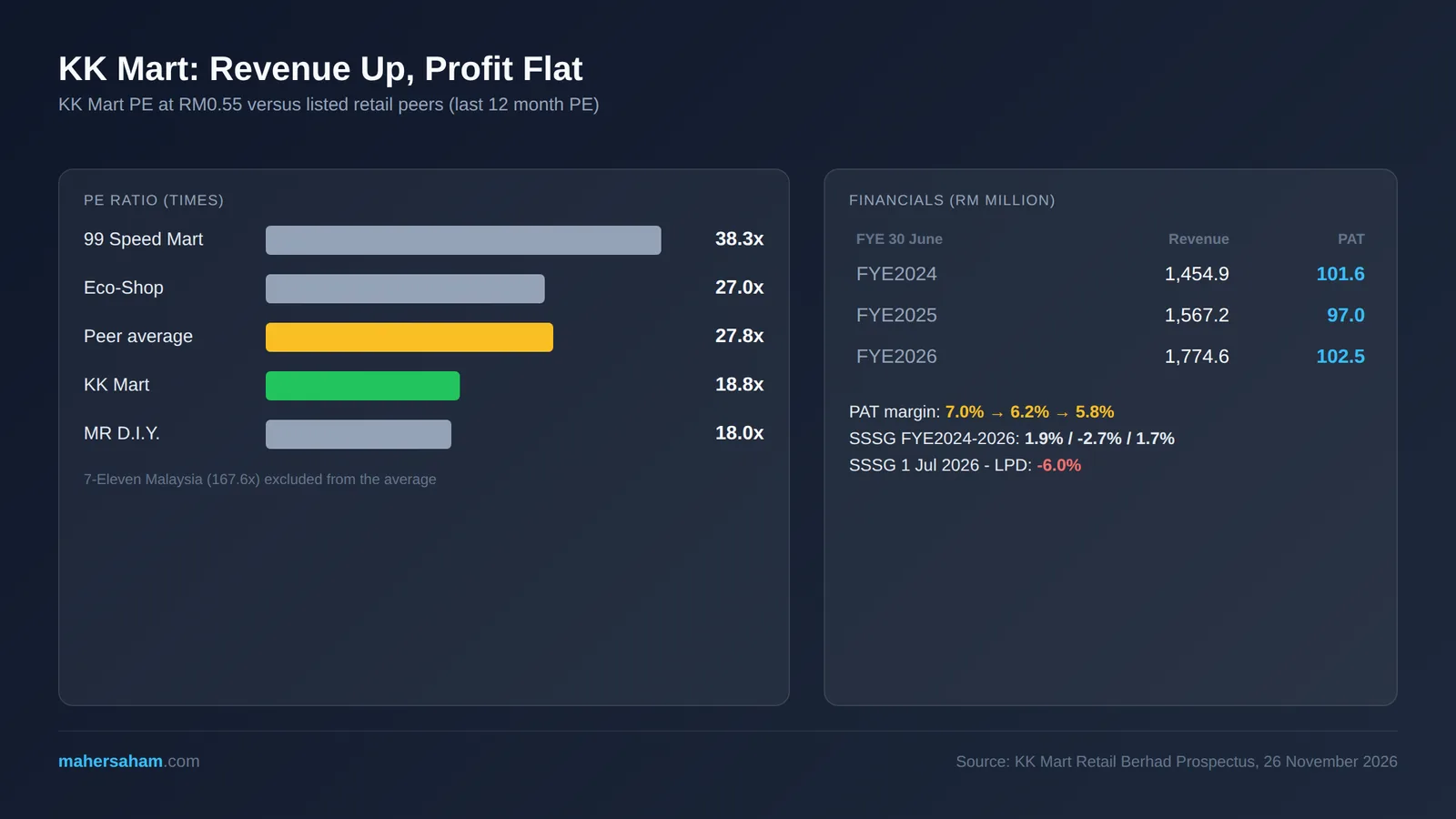
Revenue grew at a compound annual growth rate (CAGR) of 10.4% from FYE2024 to FYE2026, driven mainly by new store openings. Gross margin also improved slightly. However, PAT stayed in a range of RM97 million to RM102.5 million, so the PAT margin shrank from 7.0% to 5.8%. Rising operating costs from a larger store network absorbed almost all of the gross profit growth.
As a note, the prospectus says FYE2025 PBT would have been RM140.2 million excluding interest and dividends on redeemable convertible preference shares (RCPS), which were converted on 27 March 2026. Borrowings (excluding lease liabilities) remain low at around RM39 million, but lease liabilities for store rentals rose to RM168.2 million in FYE2026.
Same-store sales growth (SSSG) and daily sales
Same-store sales growth (SSSG) shows whether older stores are still growing. The numbers are mixed:
- FYE2024: 1.9%
- FYE2025: -2.7%, due to stopping liquor sales at stores without valid licences, negative publicity from the Sandwich Incident, and sales shifting to new stores
- FYE2026: 1.7%, helped by the SARA and SKAS programmes and resumed liquor sales
- 1 July 2026 to the LPD: -6.0%
The latest -6.0% decline stems from the rollout of a new warehouse management system at the Balakong DC on 26 July 2026. Transition disruptions caused order backlogs and delivery delays, leaving some products out of stock in stores. Before the disruption, SSSG for July 2026 was 0.9%. The company expects deliveries to return to normal by the end of 2026.
Average daily sales per store (ADSS) also fell from RM5,304 (FYE2024) to RM4,719 (FYE2026) and RM4,326 in the latest period. Average daily transactions per store dropped from 502 to 397. This is partly the cannibalisation effect of opening new stores close to existing ones.
Valuation: PE 18.8x Versus Peer Average of 27.8x
At RM0.55, KK Mart is valued at a PE of about 18.8 times, based on EPS of 2.93 sen (FYE2026 PAT of RM102.5 million divided by 3.5 billion shares). The prospectus compares it with listed retailers:
| Company | Market cap (RM million) | Last 12 month PE | EV/EBITDA |
|---|---|---|---|
| 99 Speed Mart Retail Holdings | 25,704 | 38.3x | 22.0x |
| MR D.I.Y. Group | 11,278 | 18.0x | 9.6x |
| Eco-Shop Marketing | 7,255 | 27.0x | 13.8x |
| 7-Eleven Malaysia Holdings | 2,218 | 167.6x (excluded) | 9.6x |
| Average | 27.8x | 13.8x | |
| KK Mart (at RM0.55) | 1,925 | 18.8x | 8.8x |
On paper, KK Mart is offered at a discount to the peer average. But the comparison needs context. 99 Speed Mart earns more than six times KK Mart's net profit and has faster EBITDA growth, while KK Mart's profit has not grown in three years. A lower PE can reflect slower profit growth, not necessarily a bargain. To understand how to judge PE by sector, read how to tell if a stock is cheap or expensive using PE (in Malay).
Another metric: pro forma net assets after the IPO are only RM0.10 per share. IPO investors are paying about 5.5 times book value, and the prospectus states an immediate dilution of RM0.45 per share (81.8% of the retail price). This is common for retailers whose capital base is small relative to cash flow, but worth knowing.
Dividend Policy of 40% to 60%
KK Mart targets a dividend payout of about 40% to 60% of PAT each financial year, subject to capital needs and Board approval. Before the IPO, the company paid large dividends to existing shareholders: RM113.5 million for FYE2025 (117% of PAT) and a pre-IPO dividend of RM100.0 million for FYE2026 (97.6% of PAT). IPO investors do not receive this pre-IPO dividend, and the company says no further dividends will be declared before listing.
Past Incidents: The Socks Incident and the Sandwich Incident
The prospectus discloses two product compliance incidents that generated negative publicity:
Socks Incident (March 2024). Socks bearing the word "Allah" were sold at the Bandar Sunway store. The company publicly apologised, said the socks had been supplied on a consignment basis, and withdrew the remaining stock. Three stores in Perak, Pahang and Sarawak were later targeted with petrol bombs, without major losses. On 15 July 2024, the company paid a fine of RM60,000 under Section 298 of the Penal Code for intentionally wounding the religious feelings of others, under a Shah Alam Sessions Court order.
Sandwich Incident (January 2025). Sandwiches labelled "Ham and Cheese Sandwich" bearing a Halal logo were sold at the Universiti Malaya store. Two stores on the UM campus were temporarily closed by the university but have since reopened. JAKIM and the domestic trade ministry investigated, and JAKIM confirmed the product did not have valid Halal certification at the time. The product's manufacturer did not hold a valid Halal certificate. As at the LPD, no fine or penalty had been imposed on the company over this incident.
The prospectus states these past incidents had no material impact on the group's operations or finances. However, the Sandwich Incident is cited as one cause of the negative FYE2025 SSSG, and reputational risk is listed as the first risk factor in the prospectus.
Strengths of the KK Mart IPO
- Largest convenience mart chain by store count, with a 77.6% share of the convenience mart segment in 2025.
- Consistent revenue growth, a 10.4% CAGR from FYE2024 to FYE2026, with improving gross margins.
- Strong cash generation: operating cash flow of RM168.9 million in FYE2026, a 23-day cash conversion cycle, and a store payback period of about 2 years.
- Light balance sheet: net cash position with gearing of 0.2 times.
- Valuation below the peer average: PE of 18.8x versus an average of 27.8x, and EV/EBITDA of 8.8x versus 13.8x.
- Clear dividend policy of 40% to 60% of PAT.
Risks You Need to Understand
1. Profit is not growing even as stores multiply
Stores grew from 777 to 1,106, but PAT stayed around RM100 million. Daily sales per store keep declining. If new stores keep taking sales from older ones, aggressive expansion toward 1,500 stores may not add proportionate profit.
2. Warehouse system disruption and reliance on one DC
All stores in the Peninsula depend on the Balakong DC. Warehouse management system disruptions since July 2026 have already pushed SSSG down to -6.0%. Until new DCs are ready, any disruption at Balakong can continue to affect supply.
3. Licences and compliance
As at the LPD, 39 of 1,106 stores did not yet have a Certificate of Completion and Compliance (CCC) or equivalent. Rectification costs and maximum penalties are estimated at about RM1.9 million. Only 356 stores hold liquor licences, and failure to renew licences can hurt sales or force store closures.
4. Reliance on tobacco and policy changes
Tobacco contributed 27.1% of FYE2026 store revenue (up from 22.6% in FYE2024), and the two largest suppliers are tobacco distributors. The Control of Smoking Products for Public Health Act 2024 introduced a display ban and registration requirements for tobacco and vape products, which may affect sales in this category.
5. Reputation
As the Socks and Sandwich incidents showed, a product issue at a single store can quickly hurt the whole brand, especially on religiously sensitive matters.
6. Controlling shareholder remains, and most of the IPO is an OFS
After the IPO, K8 Resources (owned by Datuk Seri Chai and his wife, Datin Seri Loh Siew Mui) still holds 73.85%. 18% of the share capital in the IPO is an offer for sale by existing shareholders, so most of the investors' money goes to them. They are subject to a 6-month moratorium after listing.
Why Is KK Mart Not Shariah Compliant?
The word "Shariah" does not appear anywhere in the KK Mart prospectus, which means there is no Shariah-compliant classification by the SC's Shariah Advisory Council for this IPO. This differs from most IPOs, whose prospectus states Shariah-compliant status. The main factor is the business activity: tobacco contributes 27.1% of store revenue, while liquor contributes about 2.5% of sales in FYE2026. One of its top five suppliers is a beer distributor.
To understand the activity benchmarks used in Shariah screening, read Shariah-compliant stock requirements in Malaysia. The official list of Shariah-compliant securities is available in the SC Shariah Advisory Council list, updated twice a year. If you want Shariah-compliant exposure to the retail sector, always check the latest status of each counter on the SC list before deciding.
Who Are the Major Shareholders After the IPO?
Before the IPO, K8 Resources held 95.05% and Arus Sejahtera 4.95%. After the IPO (without the over-allotment), the holdings become:
- K8 Resources Sdn Bhd: 73.85% (71.85% if the over-allotment option is fully exercised)
- Arus Sejahtera: 2.15%
- IPO investors: 24.0%
Datuk Seri Chai Kee Kan and Datin Seri Loh Siew Mui are deemed interested through K8 Resources and cannot sell their K8 Resources shares during the 6-month moratorium.
Frequently Asked Questions (FAQ)
What is the KK Mart IPO price?
The maximum retail price is RM0.55 per share. The final price is the lower of RM0.55 or the institutional price set on 4 December 2026. The difference is refunded if the final price is lower.
When does the KK Mart IPO application close?
Retail applications open at 10.00am on 26 November 2026 and close at 5.00pm on 2 December 2026. Balloting is on 4 December and the shares list on 15 December 2026.
Is the KK Mart IPO Shariah compliant?
No. The prospectus states no Shariah-compliant classification, and the company sells tobacco (27.1% of store revenue) and liquor. Muslim investors are advised to avoid this IPO.
How many shares are available to the public?
Only 70 million shares (2.0%) go to the Malaysian public via balloting, half for Bumiputera. Another 35 million shares (1.0%) go to eligible persons via the pink form.
Where does the KK Mart IPO money go?
Only RM115.5 million from the new share issue goes to the company, mainly for distribution centres, digital initiatives and new stores. Up to RM346.5 million from the offer for sale goes to the selling shareholders.
What is the KK Mart IPO PE ratio?
About 18.8 times, based on FYE2026 EPS of 2.93 sen. The peer average in the prospectus is 27.8 times.
Will KK Mart pay dividends?
The company targets a payout of 40% to 60% of PAT each year, subject to Board approval. This is a target, not a guarantee.
Conclusion
The KK Mart IPO brings Malaysia's largest convenience mart chain to the Main Market at a PE of 18.8 times, below its retail peers' average. Revenue grows 10.4% a year and cash flow is strong, but net profit is flat, sales per store are falling, the latest SSSG is -6.0%, and a large part of the IPO is existing owners selling shares. Most importantly for Muslim investors, this IPO is not Shariah compliant. The stock market is always uncertain, including how a share performs after listing, so make decisions based on your own research and risk tolerance.
Before applying for upcoming IPOs, make sure you already have an active CDS account.
Open a CDS trading account to invest on Bursa Malaysia as well as foreign markets such as US and Hong Kong stocks.
Download the free Stock Market Basics Ebook to understand investing fundamentals before making decisions.
Disclaimer: This article is for educational purposes and is not a recommendation to buy or sell any security. Investing involves risk and past performance does not guarantee future returns.