Malaysian Healthcare Stocks: IHH, KPJ, Sunway Medical - The Underrated Defensive Sector

When people mention defensive sectors on Bursa Malaysia, most retail investors think of utilities (TNB) or telecommunications (Maxis). The healthcare sector rarely makes the list - largely because investors feel "hospital stocks are too complex" or "premium valuation, too expensive to enter now".
But the data shows otherwise. Even when the FBM KLCI was volatile during crises (COVID-19 2020, aggressive Fed rate hikes 2022-2024), stocks like IHH and KPJ stayed stable or outperformed the broader market. The reason is simple: people still need healthcare regardless of whether the economy goes up or down.
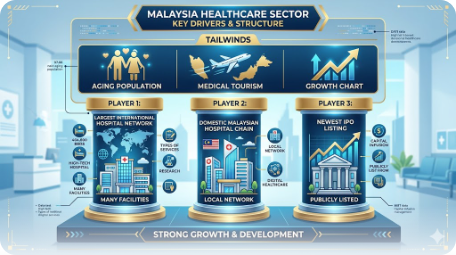
In March 2026, Bursa investors received a major addition - Sunway Healthcare Holdings (SUNMED) launched a RM2.86 billion IPO, the largest in Malaysia in 9 years. With three pure-play healthcare players now listed (IHH, KPJ, SUNMED) plus tailwinds from an aging population and medical tourism, this sector deserves more attention from retail investors.
This article dissects the three main players, the sector fundamentals, the risks many overlook, and a framework for analysing them yourself before making any investment decision.
Quick Answer
Bursa Malaysia has 3 main pure-play healthcare counters:
- IHH Healthcare (KLSE: IHH, 5225) - the largest, with 80+ hospitals across 10 countries, market cap ~RM62 billion
- KPJ Healthcare (KLSE: KPJ, 5878) - 20+ domestic hospitals, Malaysia-focused
- Sunway Healthcare Holdings (KLSE: SUNMED, 5555) - listed March 2026, includes Malaysia's largest hospital (Sunway Medical with 848 beds)
The sector is defensive because demand is inelastic (people cannot postpone treatment), driven by an aging population (7.74% of Malaysians aged 65+), and medical tourism that is expected to hit RM12 billion by 2030.
Why Healthcare Is Considered a Defensive Sector
A defensive sector is an industry where demand stays stable whether the economy goes up or down. Four main characteristics make healthcare qualify:
1. Inelastic demand
When the economy turns down, people cut holidays, gadgets, dining out - but they do not cut cancer treatment, dialysis, or heart surgery. Demand for high-acuity (complex) treatments is barely affected by economic cycles.
2. Supportive structural demographics
According to The Edge Malaysia, the percentage of Malaysians aged 65+ is 7.74% in 2026, up from 7.45% (2023) and 7.19% (2022). This trend will continue for decades. Older people = more treatments = more revenue for hospitals.
3. Pricing power
Malaysian private hospitals have the ability to raise treatment charges every year (~3-7% depending on procedure). This contrasts with sectors like retail where selling prices are pressured by online price competition.
4. Regulatory barriers limit competition
Opening a new private hospital in Malaysia requires Ministry of Health licensing, RM50-200 million in capital, and a 2-3 year approval wait. This is a moat that protects existing players.
IHH Healthcare (KLSE: IHH, 5225)
IHH is the largest healthcare player not just in Malaysia but in Asia. According to its company profile, IHH operates more than 80 hospitals in 10 countries including Malaysia, Singapore, Turkey, India, Hong Kong, and China.
Major brands:
- Pantai Hospital (Malaysia) - 11 hospitals
- Gleneagles (Malaysia, Singapore, India, Hong Kong)
- Prince Court Medical Centre (Kuala Lumpur, premium tier)
- Acibadem (Turkey, Europe)
- Mount Elizabeth (Singapore)
- Fortis Healthcare (India)
Financial profile (per Bloomberg & PitchBook September 2025):
- Market cap: ~USD12.81 billion (~RM62 billion)
- Trailing 12-month revenue: USD5.95 billion
- Net profit margin: ~10-15% (varies by quarter)
- Listing: Bursa Malaysia + SGX (dual-listed)
Recent acquisition: In November 2024, IHH acquired Island Hospital in Penang to strengthen its presence in Northern Malaysia.
What investors need to understand:
- IHH is a multinational healthcare stock - performance does not depend on Malaysia alone. A Turkish economic crisis, an Indian slowdown, or Singapore regulatory changes can all impact the stock.
- High currency exposure - revenue in multiple currencies. A strong Ringgit (like now) can suppress translated revenue.
- Premium valuation versus KPJ due to global scale, prestige brands, and emerging-market exposure.
KPJ Healthcare (KLSE: KPJ, 5878)
KPJ is the second-largest pure-play Malaysian healthcare operator. Unlike multinational IHH, KPJ is predominantly domestic.
Operating network:
- 20+ hospitals across Malaysia
- Including KPJ Damansara, KPJ Ampang Puteri, KPJ Kuching, KPJ Penang, etc.
- Subsidiary: KPJ Healthcare University (KPJUC), training medical professionals
Strategic initiative: In October 2024, KPJ launched the KPJ Health System - Malaysia's first integrated health system that combines clinical practice, education, and research within one framework.
Financial profile:
- Market cap: ~RM12 billion (current estimate)
- 2024 revenue around RM4 billion+
- Net profit margin lower than IHH (~5-8%) due to higher relative cost base
- Major shareholder: Johor Corporation (JCorp) ~49%
What investors need to understand:
- KPJ is a true proxy for Malaysian healthcare - if you want specific exposure to the domestic landscape, KPJ is more suitable than IHH.
- Its JCorp connection provides access to GLC contracts (panel hospital for state government employees).
- Risk: rising operating costs (specialist salaries, medical equipment), persistent margin pressure.
Sunway Healthcare Holdings (KLSE: SUNMED, 5555) - The New Entrant
March 2026 saw Bursa Malaysia's largest IPO in nine years. Sunway Healthcare Holdings raised RM2.86 billion at an IPO price of RM1.45 per share. On the first day of trading (18 March 2026), shares jumped 38% to close at RM1.85.
Operations:
- 5 hospitals across Malaysia
- Sunway Medical Centre Sunway City KL - Malaysia's largest private hospital with 848 licensed beds
- Sunway Medical Centre Velocity, Penang Medical Centre, etc.
- Expansion plan: 8 hospitals, 3,400+ beds by 2032
IPO profile:
- IPO size: RM2.86 billion (USD731 million)
- Projected market cap: RM16 billion
- Listing date: 18 March 2026
- Source: Bloomberg
What investors need to understand:
- This IPO is very new - historical trading data is limited. Market sentiment is still in the "discovery" phase.
- Per CIMB Securities analysis, SUNMED is highly likely to be included in the FBM KLCI by replacing QL Resources - this would add index buying from ETFs and passive funds.
- Premium valuation versus established players (IHH, KPJ) reflects the growth narrative - expanding to 3,400+ beds in 7 years is aggressive. Investors must judge whether this premium is warranted.
- Parent company is Sunway Berhad (KLSE: SUNWAY) - the Cheah family, one of Malaysia's oldest conglomerates.
Industry Tailwinds: What Supports Growth
Several drivers in this sector that investors should understand:
1. Structural aging population
The growth in those aged 65+ cannot be reversed. Each year, the elderly population rises consistently - meaning demand for geriatric care, dialysis, cancer, and heart surgery rises.
2. Medical tourism (Visit Malaysia Year 2026 + MYMT 2026)
Malaysia's private sector attracted 1.84 million international patients in 2025 and generated RM3.34 billion in revenue per The Edge Malaysia. The Malaysia Healthcare Masterplan targets RM12 billion by 2030 (32% CAGR).
3. Shift to high-acuity treatments
Malaysian private hospitals are moving toward complex treatments (heart surgery, oncology specialists, transplants) which carry higher margins than routine care. This supports both pricing and revenue.
4. Overcrowded government hospitals
Ministry of Health hospitals (Hospital Kuala Lumpur, Hospital Selayang, etc.) are perennially congested - patients who can afford it shift to private. This trend is structural support for private hospital volume.
5. Private medical insurance growth
The growth of insurance and medical card products in Malaysia supports patients' access to more expensive private hospital care.
Industry Headwinds: Risks Investors Must Know
The sector is not without risks. Several major headwinds:
1. Medical insurance reform & claims pressure
Per MBSB Research as reported by The Edge, the Ministry of Health, Ministry of Finance, and Bank Negara Malaysia are working together to control pricing and claims inflation. When this reform takes effect, private hospitals may experience short-term margin compression because they cannot raise charges as freely as before.
2. Manpower shortage
Malaysian specialist doctors are in short supply - many migrate to Singapore, Australia, or the UK for better packages. Hospitals must raise salaries to retain talent, pressuring margins.
3. High capex
Building new hospitals or upgrading equipment (MRI, CT scan, robotic surgery) requires RM50-200 million in capex. Free cash flow for healthcare players tends to be pressured by long-term capex.
4. Regulatory & political risk
Government policy can change - examples: treatment price caps, drug procurement reform, coverage mandates. The Ministry of Health can set ceiling prices for certain treatments.
5. Currency exposure (for IHH)
IHH has operations in Turkey (volatile Lira), India (Rupee), Singapore. A strengthening Ringgit can suppress translated revenue.
6. Premium valuation
Malaysian healthcare stocks (especially IHH, SUNMED) trade at PE ratios of ~30-40x. This is higher than the broader market (~14-16x). The margin of safety is smaller than in other sectors.
How to Analyse Healthcare Stocks: The Right Metrics
For retail investors who want to do their own research, several important metrics beyond the PE:
1. Revenue per bed
This is the most fundamental hospital metric. Total annual revenue ÷ number of licensed beds. It helps compare performance between players. As a guide, tier-1 Malaysian hospitals have revenue per bed of ~RM1.2 - 1.8 million/year.
2. Bed Occupancy Rate (BOR)
Percentage of beds filled at any time. Optimal: 65-80%. Too low = excess capacity; too high = limited room to grow.
3. EBITDA margin
Hospitals are a capital-heavy industry. EBITDA margin is more representative than net margin because it removes the depreciation effect. Industry average: 18-25%.
4. Net debt / EBITDA
Hospitals often carry debt for capex. A ratio under 3x = healthy. IHH historically maintains ~2x. KPJ ~3-4x.
5. International patient mix
For players with medical tourism exposure (IHH, SUNMED), the percentage of revenue from foreign patients matters. IHH Singapore ~40%, KPJ Malaysia ~10-15%.
6. Capex intensity
Capex ÷ Revenue. For hospitals in a growth phase: ~10-15% is reasonable. Higher figures indicate aggressive expansion (currently SUNMED).
Data sources: Company Annual Reports (downloadable from Bursa Malaysia investor portal), KLSE Screener, ShareInvestor, or analyst reports from banks like CIMB, MIDF, Maybank.
Investor Strategy for the Healthcare Sector
Once again - this article is NOT a buy/sell recommendation for any specific stock. But for investors who have done their own research, several strategic considerations:
For long-term investors (5+ years):
- Focus on companies with structural moats - premium locations, brand recognition, network effects
- Track demographic trends - Asia's aging population will continue to grow
- Be patient with short-term volatility - the sector tends to be defensive but not without drawdowns
For dollar cost averaging (DCA):
- Healthcare suits DCA because volatility is relatively low
- Buy consistently each month without trying to time the market
- Reinvest dividends (both IHH and KPJ pay dividends regularly)
For sector diversification:
- Healthcare can be 5-15% of the portfolio (defensive, not the main growth driver)
- Combine with cyclical sectors (banks, plantation) for balance
For new investors:
- Start with one player (the most familiar) and understand the fundamentals
- Do not buy all three at once - they are too correlated, you would not actually be diversifying
- Read at least 1-2 years of Annual Reports before deciding
For more fundamental analysis frameworks, read PE Ratio: How to Know if a Stock Is Expensive or Cheap by Sector in Malaysia.
FAQs
What is the largest healthcare stock on Bursa Malaysia?
IHH Healthcare (KLSE: 5225) is the largest healthcare stock with a market cap of ~RM62 billion. Followed by Sunway Healthcare Holdings (KLSE: 5555 SUNMED) at a projected RM16 billion, and KPJ Healthcare (KLSE: 5878) at ~RM12 billion.
Are healthcare stocks shariah-compliant?
Status depends on the SAC (Shariah Advisory Council) review. Shariah status can change with periodic reviews. You can check the latest status on the Bursa Malaysia website or screener apps like SharLife to confirm before any investment decision.
Why are healthcare stocks considered defensive?
Healthcare demand stays stable whether the economy goes up or down. People cannot postpone cancer treatment, dialysis, or heart surgery. Combined with tailwinds from an aging population and medical tourism, the sector is structurally defensive.
Is Sunway Healthcare (SUNMED) different from Sunway Berhad?
Yes. Before March 2026, exposure to Sunway Medical was only available through Sunway Berhad (KLSE: SUNWAY). Now SUNMED is a separate listing - pure-play healthcare. Sunway Berhad still has exposure (as a major shareholder) but is diversified into property, education, leisure.
How does medical tourism affect Malaysian healthcare stocks?
International patients usually pay more and for complex treatments (high margin). 2025 saw 1.84 million foreign patients generating RM3.34 billion. The RM12 billion target by 2030 is momentum that supports tier-1 hospital revenue growth.
Are healthcare stock dividends generous?
Healthcare dividend yields in Malaysia are typically 1-2.5% - low compared to REITs (5-7%) or banks (4-5%). This is because most earnings are reinvested for capex (new hospitals, equipment). Income-focused investors may pick other sectors; growth-focused investors may find this more suitable.
What is the biggest risk healthcare investors should know?
Three main risks: (1) Medical insurance reform that may pressure margins, (2) manpower shortage that raises operating costs, (3) premium valuation that reduces the margin of safety if growth slows.
Should I buy IHH or KPJ?
This article does not give buy/sell recommendations. The choice depends on your risk profile, horizon, and own research. IHH = global exposure + brand premium. KPJ = pure-play Malaysia + slightly higher dividend. SUNMED = growth story + still new. Do your own DYOR before deciding.
Conclusion
Healthcare is one of the most underrated sectors on Bursa Malaysia. With Sunway Healthcare's entry to the market in March 2026, investors now have three large pure-play options to choose from (IHH, KPJ, SUNMED). Tailwinds from an aging population, medical tourism, and structural undersupply of private hospitals provide long-term support. But premium valuation, insurance reform, and manpower shortage are real risks investors cannot ignore.
Before making any investment, understand the fundamentals of each player, read the Annual Reports, and structure the portfolio according to your risk profile. Once again, this article is NOT a buy/sell recommendation - it is sector analysis for educational purposes.
Before you start investing in any stock, you need access to Bursa Malaysia through a trusted broker platform.
Open a CDS trading account today to start investing in Bursa Malaysia as well as overseas markets including US and Hong Kong stocks through one platform.
Download our free stock market basics ebook to understand investment fundamentals before taking the next step.
Further Reading
- PE Ratio: How to Know if a Stock Is Expensive or Cheap by Sector
- How to Read an Income Statement: Revenue, Net Profit & Cash Reality
- Balance Sheet 101: Assets, Liabilities & Shareholder Equity
- Core vs Headline Inflation: Which Should Investors Follow?
- Falling Ringgit - What It Means for Bursa Malaysia Investors