US Midterm Elections Explained: What They Mean for Wall Street & Bursa

Today, 3 November 2026, Americans are voting in the US midterm elections. President Donald Trump is not on the ballot, but tonight's results will decide whether he still has a Congress willing to back him for the final two years of his term.
Why should investors in Malaysia care? Because the US Congress controls the budget, taxes and borrowing of the world's largest government. All of that moves Wall Street, the US dollar and bond yields, and ultimately the flow of money into emerging markets such as Bursa Malaysia.
In this article, we explain in plain language:
- What the US midterm elections are and how Congress works
- What is at stake in 2026 and the issues shaping the vote
- When results come in, in Malaysian time
- Three possible outcomes and what each means for markets
- What history says about the S&P 500 and FBM KLCI after midterms
The Short Answer: What Are the US Midterm Elections?
The midterm elections are US general elections held two years after a presidential election, in the "middle" of the president's four-year term. Voters choose all 435 members of the House of Representatives, roughly one third of the 100 Senate seats, and many governors and state officials. The president is not elected, but the vote is widely treated as a "referendum" on the president's performance.
They are always held on the Tuesday after the first Monday of November in even-numbered years, which is why this year's date is 3 November.
How the US Congress Works (Short Version)
The US system separates power between the president (the executive) and Congress (the legislature). Congress has two chambers:
- House of Representatives - 435 members, each representing one district. Terms last only two years, so every seat is up every time. A majority needs 218 seats. All tax and spending bills start here.
- Senate - 100 members, two per state. Terms last six years, and about a third of seats are contested every two years. A majority needs 51 seats (or 50 plus the Vice President's tie-breaking vote). The Senate also confirms judges and cabinet members.
Two more numbers matter: most bills need 60 Senate votes to end debate (the filibuster), and Congress needs a two-thirds vote in both chambers to override a presidential veto. So even when one party wins narrowly, it rarely has unchecked power.
If you are familiar with Malaysia's system, think of the Dewan Rakyat and Dewan Negara, except that both are elected and both can block each other. That is what makes the midterms so important for US policy.
What Is at Stake on 3 November 2026
According to Wikipedia's 2026 Senate elections page and its 2026 House elections page, the line-up going into the vote is:
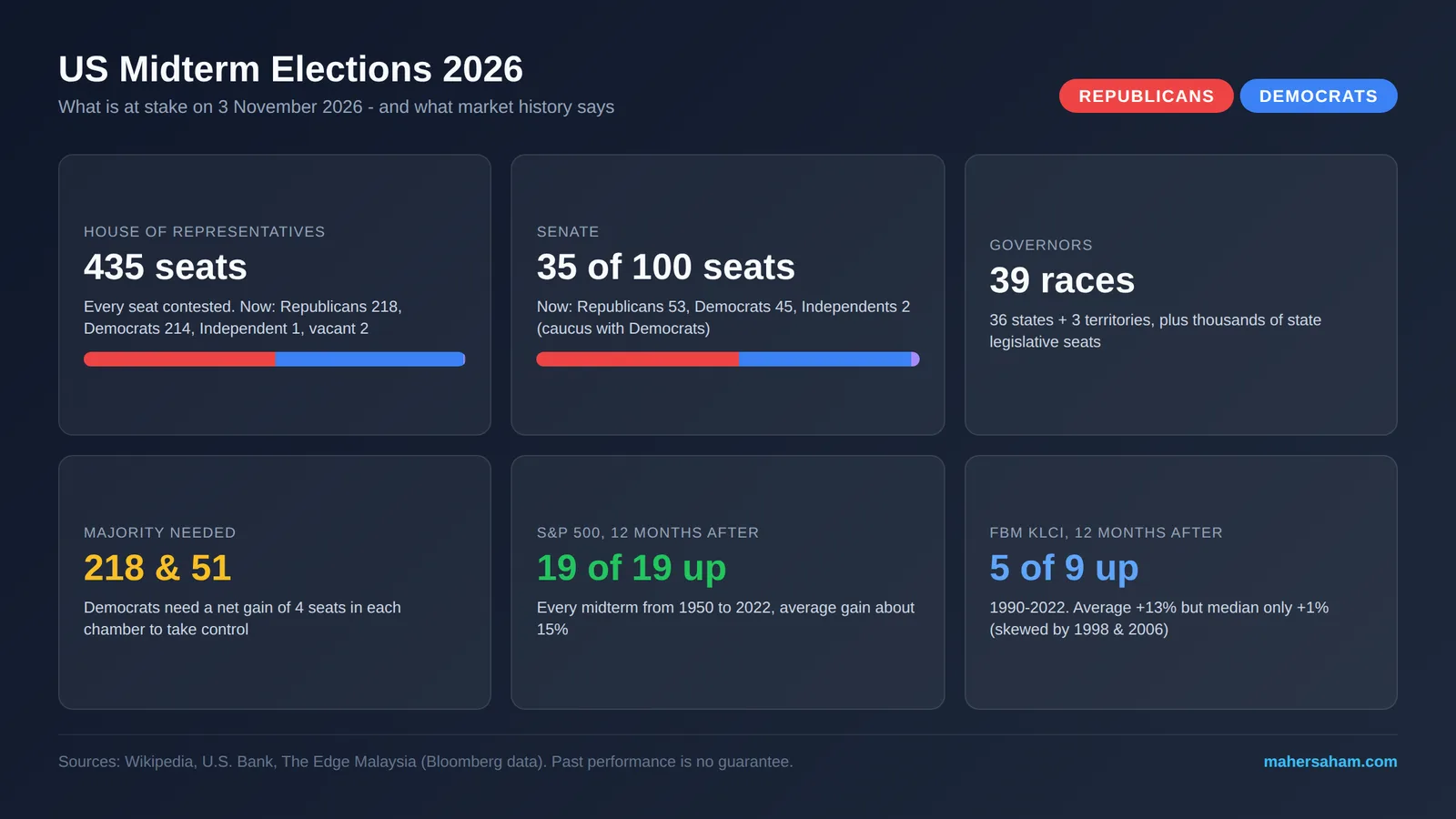
- House: Republicans 218, Democrats 214, Independent 1, and 2 vacant seats. All 435 seats are contested.
- Senate: Republicans 53, Democrats 45, and 2 Independents who caucus with the Democrats. 35 seats are up - 33 regular seats plus 2 special elections in Ohio (JD Vance's former seat) and Florida (Marco Rubio's former seat).
- Governors: 39 races (36 states and 3 territories).
Democrats need a net gain of 4 seats in each chamber to take control. In the Senate, Republicans are defending 22 seats against 13 for Democrats, so this year's map exposes Republicans more.
Another factor: 11 senators chose to retire (the most since 1996), and 60 House members are not seeking re-election. More open seats means more races that are hard to call.
The Issues Shaping the Vote
This election takes place against a tense economic backdrop. The most discussed issues include:
- Cost of living - petrol, food and healthcare prices. A Reuters/Ipsos poll in October found 76% of Americans blamed Trump's policies for higher inflation, including 57% of Republicans.
- Tariffs - after the US Supreme Court struck down the emergency-power tariffs in February, the administration switched to Sections 301 and 232.
- The Iran war - the conflict that began on 28 February 2026 pushed oil and diesel prices to highs.
- Immigration, AI data centres and democracy concerns - including disputes over mid-decade redistricting in several states.
In numbers, Trump's approval rating fell to 31% in mid-October according to Reuters/Ipsos, the lowest of either of his terms. The final New York Times/Siena poll, reported by Forbes, showed Democrats leading nearly every key Senate race, including Michigan, Ohio, Maine and Texas.
The Senate Races to Watch
The House is expected to change hands more easily, so markets are focused on the Senate. The deciding states:
- Michigan and Georgia - Democratic seats in states Trump won narrowly in 2024. Michigan is an open seat after Gary Peters retired.
- Maine - Susan Collins is the only Republican defending a seat in a state Kamala Harris won.
- North Carolina - an open seat after Republican Thom Tillis retired.
- Ohio (special) - Jon Husted, appointed to replace JD Vance, must defend the seat.
- Texas - long-serving senator John Cornyn lost his own party's primary, opening up a more competitive race.
Democrats are also campaigning hard in Kansas and Alaska, states that are usually safe for Republicans.
What Forecasts and History Say
History favours the opposition. According to UOB data cited by The Edge Malaysia, the president's party lost House seats in 18 of the 20 midterms from 1946 to 2022, losing about 26 seats on average. The only exceptions were 1998 and 2002.
Prediction markets lean Democratic too. On 22 October, Polymarket gave Democrats a 92% chance of winning the House and 67% for the Senate. Decision Desk HQ's model (as of late September) put the odds of Democrats winning both chambers at 52%, a Democratic House with a Republican Senate at 23%, and Republicans keeping both at 23%.
Remember, forecasts are not results. In 2016, most models were badly wrong. A market that has already "priced in" a Democratic win can move sharply if the outcome is different.
When Will Results Come In? (Malaysian Time)
In November, Malaysia is 13 hours ahead of US Eastern Time (ET). According to 270toWin's poll closing schedule:
- The first polls close at 6pm ET in Indiana and Kentucky, which is 7am on Wednesday, 4 November in Malaysia.
- Most East Coast states close by 8pm ET, which is 9am in Malaysia.
- The last polls close in Alaska at 1am ET, which is 2pm in Malaysia.
So Bursa Malaysia will be trading all of Wednesday while results come in. But do not expect final results the same day. In 2022, the House majority was only called on 16 November, eight days after the vote, because mail-in ballots and close races take time to count.
Three Scenarios and What They Mean for Markets
Scenario 1: Democrats Win Both Chambers
This is the most widely forecast outcome. Trump remains president, so the result is a fully divided government. The president's legislative agenda would almost certainly stall, and Democrats could open congressional investigations. Trump's promise of US$5,000 for every adult if Republicans win (estimated cost US$1.25 trillion) would not pass.
For markets, that means less large new fiscal spending, which in theory could ease pressure on US bond yields. One analyst interviewed by The Edge argued a divided government is better for emerging markets.
Scenario 2: Democrats Take the House, Republicans Keep the Senate
A split Congress. The House could block spending bills, including the US$1.5 trillion FY2027 defence budget request, but a Republican Senate could still confirm judges and officials. This is the classic "gridlock" scenario Wall Street knows well.
Scenario 3: Republicans Keep Both Chambers
This would be a surprise relative to the polls. Trump could push ahead with his fiscal agenda, including possible cash payments and more tax cuts. Stocks might react positively in the short term, but worries over deficits and national debt (already US$40 trillion in October 2026) could push bond yields higher.
What Does Not Change
Many investors overlook this: tariffs, sanctions and foreign policy largely remain with the president, not Congress. UOB and Bloomberg Intelligence expect tariff risk to continue into 2027 whoever wins. The Trump policy pattern we discussed in Trump Always Chickens Out (TACO) remains relevant.
After the election, Congress also has to fund the government by 11 December and pass the defence bill by year-end. A government shutdown risk may move markets more than the vote itself.
What History Says: The S&P 500 After Midterms
This is the most interesting part for investors. A U.S. Bank Asset Management study covering 31 midterms since 1900 found:
- In the 12 months before a midterm, US stocks averaged only 2.9%, compared with 8.9% across all years.
- In the 12 months after a midterm, the average return jumped to 12.4%, and 17.5% for elections since 1980.
The Edge's analysis of Bloomberg data is even more striking: the S&P 500 was higher 12 months after every one of the 19 midterms from 1950 to 2022, with an average and median gain of about 15%. It was also higher six months later every time.
Why? The most accepted theory is that political uncertainty fades once results are known, and divided government tends to restrain drastic policy change. But U.S. Bank itself cautions that its statistical test did not show a dependable "midterm effect", and the return gap between unified and divided government was not significant either. Economic factors such as inflation, interest rates and corporate earnings matter far more.
There have been short-term dips. Three months after the vote, the S&P 500 was down 7% (2002) and 0.2% (2018). So the 12-month pattern does not mean the market will rise tomorrow. If you are new to US indices, start with the difference between the Dow Jones, S&P 500 and Nasdaq.
Impact on Bursa Malaysia and the Ringgit
For the FBM KLCI, the record is less consistent. Across 9 midterms between 1990 and 2022, the KLCI was higher 12 months later only 5 times. The average gain looks high (+13%), but the median is just +1% because of two outlier years: +74% after 1998 (the Asian financial crisis recovery) and +42% after 2006.
The lesson: Bursa is driven more by local and regional factors. This matches what we found in our article on the KLCI pattern around Malaysian general elections - what moves markets is a change in uncertainty, not the election itself.
Local analysts quoted by The Edge differ on how much it matters. One rated the election 4 out of 10 in importance for markets, while Imran Yusof of MBSB Investment Bank rated it 8 out of 10 but expects the impact to be indirect, with the Middle East conflict remaining the biggest factor.
The channels to watch:
- 10-year US Treasury yield - it hit 5.34% on 1 October, the highest since 2002. High yields pull money out of emerging markets. This is closely tied to Fed decisions and their impact on the ringgit.
- US dollar and ringgit - a divided government with tighter fiscal discipline could soften the dollar slightly, which supports the ringgit.
- Foreign fund flows - watch weekly data to see whether funds return to Bursa. Our guide to reading foreign fund flow data explains how.
- Export sectors - semiconductors, gloves and electrical and electronics are most exposed to US trade policy.
What Should Malaysian Investors Do?
- Do not trade on election-night headlines. Early results often shift once mail-in ballots are counted. Sharp swings on Wednesday and Thursday do not necessarily reflect the long-term direction.
- Review your exposure to US stocks. If you hold US shares or ETFs, identify the policy-sensitive sectors such as defence, healthcare, energy and banks. Remember currency risk too.
- Focus on economic data, not politics. Inflation reports, Fed meetings and quarterly earnings will remain the main drivers.
- Invest regularly. Strategies such as dollar cost averaging reduce the risk of mistiming your entry when markets are volatile.
- Choose instruments that fit your principles. Muslim investors have Shariah-compliant ETF options for exposure to the US market.
If this is your first time considering the US market, read what Malaysian investors must know before investing in US stocks.
Frequently Asked Questions (FAQ)
What is the difference between the midterms and the presidential election?
The presidential election is held every four years and elects the president and Congress. The midterms are held two years later and only elect Congress, governors and state offices. The president is not on the ballot.
When are the 2026 US midterm elections?
Tuesday, 3 November 2026, US time. Polls close between 7am and 2pm on Wednesday, 4 November, Malaysian time.
How many seats are being contested?
All 435 House seats, 35 of the 100 Senate seats, and 39 governorships, plus thousands of state legislative seats.
Can Trump lose office if Democrats win?
No. Trump remains president until January 2029. A Democratic win only gives them the power to block bills and run investigations. Removal through impeachment needs a two-thirds Senate vote, which is very hard to reach.
Does the US stock market usually rise after midterms?
Historically, yes. The S&P 500 has been higher 12 months after every midterm since 1950. But this is no guarantee, and experts say economic factors matter more than election results.
How do US election results affect Bursa Malaysia?
Mostly indirectly, through US bond yields, the dollar, foreign fund flows and trade policy. The KLCI's record after midterms is mixed, with a median gain of only about 1% over 12 months.
Will Trump's tariffs end if Democrats control Congress?
Not automatically. Tariff powers under Sections 301 and 232 sit with the president. Congress can try to limit them through legislation, but Trump can veto it, and overriding a veto needs a two-thirds vote.
Should I sell my stocks before the results are announced?
For long-term investors, selling purely because of an election rarely pays off. Keep your portfolio balanced, hold enough cash, and base decisions on company fundamentals.
Conclusion
The 2026 US midterm elections decide who controls Congress for Trump's final two years, and the polls lean towards a Democratic win. History shows Wall Street tends to be firm after midterms, but the effect on Bursa Malaysia is more mixed and depends heavily on bond yields, the dollar and the Middle East conflict.
Global events like this are the best chance to understand how world markets connect, and to get ready with your own investment account.
Open a CDS trading account to start investing on Bursa Malaysia as well as foreign markets such as US and Hong Kong stocks.
Download the free Stock Market Basics Ebook to learn stock investing step by step.
Further Reading
- Elections & Bursa Stocks: The Real KLCI Pattern Before and After Malaysian General Elections
- Trump Always Chickens Out (TACO): From Tariff Wars to Iran, the Pattern Every Investor Must Know
- The Fed Meets This Week: What Bursa Malaysia Investors Should Watch
- Investing in US Stocks from Malaysia: 7 Things You Must Know First
- Trump-Xi in Beijing, Sultan Ibrahim in Moscow: Malaysian Investors Between BRICS and the US