Profit Up but Business Weak? How to Read a Quarterly Report Properly

On 5 November 2026, two large Bursa Malaysia companies announced their quarterly results on the same day, and both headlines could mislead you if you only skimmed them.
Headline one: SD Guthrie's net profit fell 17%. Headline two: F&N's net profit rose 18%. Stop there and you might conclude SD Guthrie is weakening while F&N is getting stronger. The reality is almost the opposite. SD Guthrie's core profit actually jumped, while F&N's increase came from a smaller tax bill, not from a faster-growing business.
This article teaches a skill many retail investors skip: separating core profit from one-off profit in a quarterly report. It applies every earnings season, to any counter.
Quick Summary
- Reported net profit includes everything: day-to-day business, asset sales, fair value gains, tax and exceptional items.
- Core profit is profit from day-to-day operations after one-off items are removed. It is the better measure of trend.
- The three main sources of "false profit" or "false loss": asset or land sales, fair value changes, and unusually low or high tax.
- Compare profit before tax (PBT) with profit after tax (PAT). If PBT is flat but PAT rises, tax is doing the lifting.
- Always read the explanatory notes in the Bursa filing, not just the news headline.
Why Quarterly Results Headlines Often Mislead
Every company listed on Bursa Malaysia must publish its quarterly financial report within two months after the quarter ends. You can read these reports free of charge on the Bursa Malaysia company announcements page.
The problem is that journalists and investors usually focus on one number: net profit versus last year. It makes an easy headline, but it combines two very different kinds of profit:
- Recurring profit: earnings from selling products and services, which will happen again next quarter.
- One-off profit: land sales, disposal of subsidiaries, revaluation gains, compensation or tax adjustments. These may not recur.
If last year's quarter had a large one-off gain, this year's quarter will look like a "drop" even if the business has actually improved. Conversely, a quarter helped by a one-off item can look excellent while day-to-day business is flat.
That is why analysts always talk about core net profit. They are trying to strip out the noise so the real trend shows.
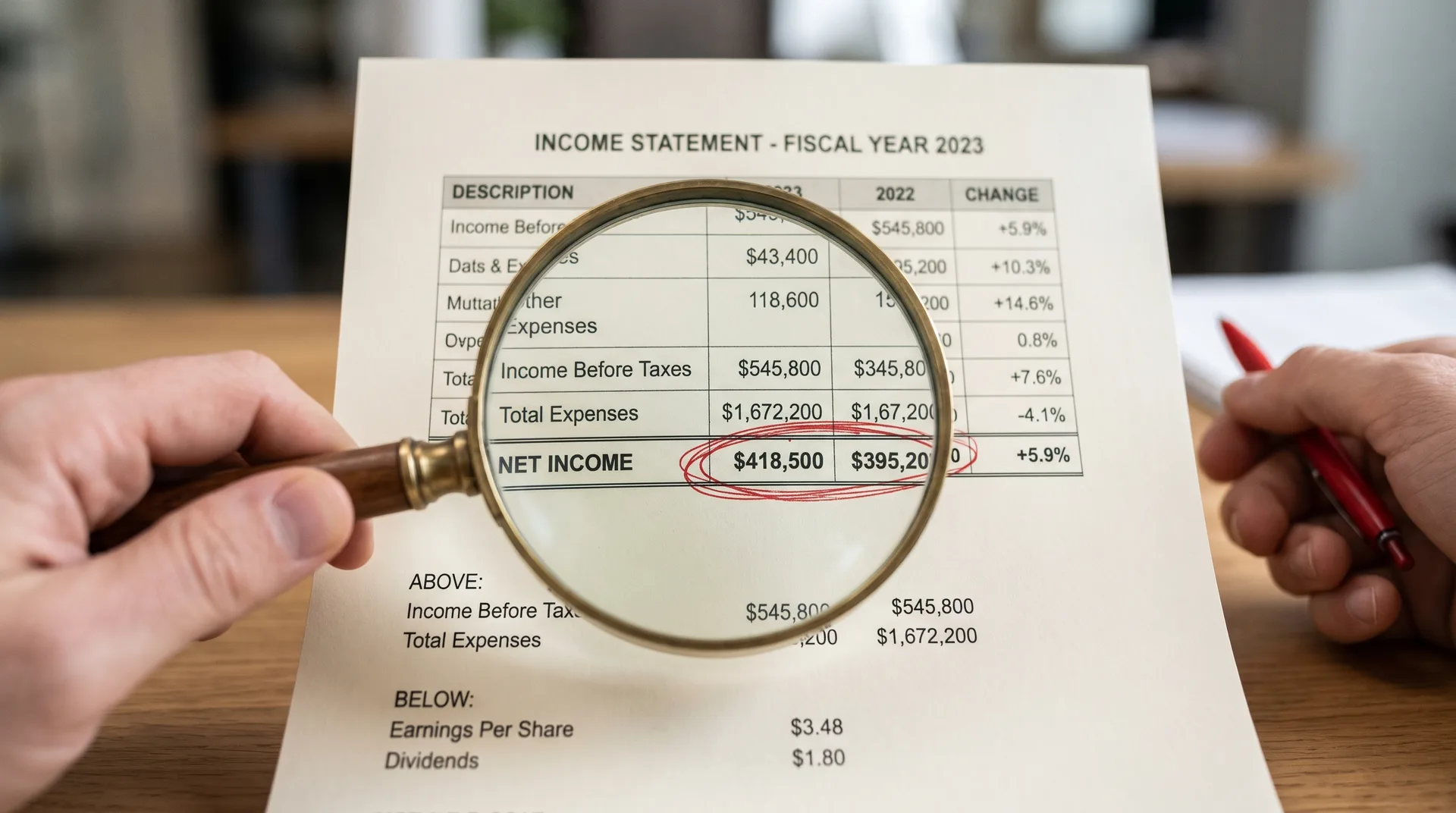
Case Study 1: SD Guthrie, Profit Down but Core Surging
SD Guthrie, the world's largest palm oil planter by planted area, reported net profit of RM773 million for the third quarter of 2026, down 17.3% from RM935 million a year earlier, according to the New Straits Times.
Read deeper and the picture changes.
Where did the drop come from?
SD Guthrie is not just a palm oil company. It also owns a very large land bank and sells part of it for industrial development. The industrial segment posted pre-tax profit of RM81 million this quarter against RM432 million a year earlier, due to lower contributions from land disposals (NST). Last year's quarter had a large land sale. This year's was smaller.
In other words, the 17% "drop" is largely the result of comparing against a quarter with an exceptional land gain, not because its plantations were weak.
What does core profit say?
According to The Star, after excluding one-off disposal gains and fair value items, core net profit for 3Q2026 jumped 39.4% year-on-year and 30% quarter-on-quarter to RM693 million.
So the same report tells two opposite stories:
| Measure | 3Q2026 | Year-on-year change |
|---|---|---|
| Reported net profit | RM773 million | Down 17.3% |
| Core net profit | RM693 million | Up 39.4% |
The roughly RM80 million gap between the two numbers is the excluded items (our calculation from the two reported figures). And if core profit rose 39.4% to RM693 million, core profit in the same quarter last year was only around RM497 million (also our calculation). That means a large part of last year's RM935 million came from non-core items.
What drove core profit?
The real engine was the upstream (plantation) segment. NST reported upstream pre-tax profit rose 48%, supported by higher fresh fruit bunch production and better crude palm oil prices. That kind of profit recurs as long as output and prices hold.
The lesson for you
For companies that own large assets such as land, property or stakes in other companies, net profit will always "jump around" depending on when assets are sold. Do not judge their performance on one quarter. Look for the core number, or strip out the asset-sale gains stated in the report notes yourself.
This also applies going forward. The Star reported that analysts expect fourth-quarter momentum to be helped by recognition of land sales in Seberang Perai and Port Dickson. When the fourth-quarter numbers come out, reported net profit may look high. The right question is: how much of it came from plantations, and how much from land?
Case Study 2: F&N, Profit Up Because of Tax
Fraser & Neave Holdings (F&N), the beverage and dairy maker, reported fourth-quarter net profit (quarter ended 30 September 2026) up 18.2% to RM135.05 million from RM114.29 million, according to a report by The Sun republished on Newswav.
That headline is positive. But look at the layer underneath.
PBT flat, PAT up
The same report states that profit before tax was broadly stable at RM169.42 million versus RM169.07 million a year earlier. Meanwhile, profit after tax rose 16.3% to RM137.26 million, "mainly due to lower tax expense", as reported by The Star.
This is the simplest test you can do yourself in 30 seconds:
- PBT up, PAT up → the business really improved.
- PBT flat, PAT up → the increase came from tax, not operations.
- PBT up, PAT down → the business did well, but the tax bill jumped (possibly temporarily).
From the reported PBT and PAT figures, F&N's tax bill this quarter was around RM32 million versus around RM51 million a year earlier (our calculation). Lower tax can come from incentives, prior-year adjustments or tax allowances. It is legitimate and the money is real, but it will not necessarily recur next quarter.
Another layer: a disposal gain
The Star also reported that operating profit for the quarter was broadly unchanged at RM173.7 million, including a RM90.5 million pre-tax gain from selling its 50% stake in Vacaron Company Sdn Bhd. Quarterly revenue fell 3.1% to RM1.19 billion, hit by weaker sales to Cambodia amid border closures and unfavourable currency movements.
Put it all together: revenue down, operating profit supported by a disposal gain, and net profit lifted by lower tax. For the full financial year 2026, F&N's net profit actually fell 14% to RM437.09 million from RM508.47 million (Newswav), and the total annual dividend was 60 sen versus 65 sen the year before (The Star).
This does not mean F&N is a weak company. It means the headline "quarterly profit up 18%" does not describe the direction of the business. The real picture comes from reading several numbers together.
Five Types of One-Off Items That Show Up Often
When you open a quarterly report, look for the following in the income statement and the explanatory notes (usually the "Review of Performance" section and the "Profit before tax is arrived at after charging/(crediting)" note):
1. Gains or losses on asset disposals
Sales of land, buildings, subsidiaries or stakes in associates. SD Guthrie and F&N both had items like this in the same quarter. These can be worth hundreds of millions and dwarf normal operating profit.
2. Fair value changes
Under the MFRS accounting standards used in Malaysia, some assets such as investment properties, biological assets and financial instruments are revalued every period. Increases in value are recorded as profit even though no cash comes in. REITs and property companies are highly exposed to these items.
3. Impairments and write-offs
The reverse: one-off losses when the value of an asset is written down, for example goodwill from an old acquisition or inventory that cannot be sold. One large impairment can turn a profitable quarter into a loss.
4. Unusual tax
As in the F&N case, the effective tax rate can swing because of incentives, tax losses carried forward, or prior-year tax adjustments. Malaysia's standard corporate tax rate is 24%. If the effective rate for the quarter is very different, ask why.
5. Compensation, insurance claims and legal settlements
Compensation for government land acquisition, insurance payouts after a fire, or court settlements. All real money, but not recurring.
Step by Step: Reading a Quarterly Report in 10 Minutes
You do not need to be an accountant. Follow this order every time a quarterly report comes out:
- Read revenue first. Revenue is rarely affected by one-off items. If revenue rises consistently, the business is growing.
- Compare PBT with PAT. Use the 30-second test above to see whether tax played a big role.
- Search the explanatory notes for key words: "gain on disposal", "fair value", "impairment", "one-off", "non-recurring", "write-back", "compensation".
- Roughly subtract those items. Reported net profit minus one-off gains (or plus one-off losses) gives an estimate of core profit.
- Compare with the same quarter last year, and check whether last year's quarter also had one-off items. This is the SD Guthrie trap: last year had a large land sale.
- Look at operating cash flow in the annual or half-year report. Fair value gains bring in no cash; cash flow exposes them.
- Read analyst notes or media coverage that mention "core net profit". It is a good shortcut, but check whether the definition is reasonable.
Common Mistakes by Retail Investors
- Acting on the headline alone. Share prices sometimes move in the first minutes after results come out, based on reported net profit. Careful readers often find that reaction pointed the wrong way.
- Calculating PE with one-off profit. A PE ratio calculated on profit inflated by a land sale will look falsely "cheap". Use core profit. Read more on using the PE ratio by sector.
- Assuming dividends follow net profit. Boards usually set dividends based on core profit and cash flow. If net profit rose because of a one-off, do not expect dividends to rise as much. The F&N case shows the annual dividend was actually lower. See the guide to dividend yield and payout ratio.
- Forgetting that "core" can be gamed too. Companies sometimes label recurring losses as "one-off" every quarter. If an "exceptional item" appears every year, it is no longer exceptional.
How This Fits Into Fundamental Analysis
Reading core profit is one of the foundations of fundamental analysis. The income statement tells you how much profit the company made on paper. The cash flow statement tells you whether that profit turned into real money. If you are just starting, first read how to read an income statement and how to read a cash flow statement. Then come back to this article for the next layer.
Earnings season also often makes prices move violently. If you also look at charts, the guide to reading charts during earnings season complements what you have learned here.
Frequently Asked Questions (FAQ)
What is the difference between net profit and core profit?
Net profit is all profit after tax, including one-off items. Core profit removes items such as asset-sale gains, fair value changes and impairments so you can see how the day-to-day business is performing.
Are companies required to report core profit?
No. Accounting standards require net profit to be reported. Core profit is usually calculated by analysts or disclosed voluntarily by companies in press statements. You can estimate it yourself from the report notes.
Where can I read quarterly reports of Bursa-listed companies?
On the Bursa Malaysia company announcements page, under the financial results category. Most companies also upload their reports in the investor relations section of their websites.
Why does a share price fall even when net profit rises?
One reason is that the market sees the increase came from one-off items or tax, while core profit or revenue was actually weak. Other reasons include results below analyst expectations or more cautious management guidance.
Is a gain from a land sale a bad thing?
No. It is real money and can be used to pay down debt, reinvest or pay a special dividend. It just should not be used to judge the business trend or to calculate the PE ratio as if it will recur every quarter.
How do I know whether an item is one-off or recurring?
Check several quarters back. If the same item appears almost every quarter, treat it as part of the business. If it appears once and is explained as a specific transaction, it is one-off.
What is the effective tax rate and why does it matter?
The effective tax rate is tax paid divided by profit before tax. If this rate is much lower than the standard corporate rate, that quarter's net profit may have been inflated by a temporary tax factor.
Should I ignore net profit completely?
No. Net profit is still the official figure audited at year end. Use both: net profit to know what happened overall, core profit to know where the business is heading.
Conclusion
One quarterly report can produce two opposite headlines, depending on which number you read. The SD Guthrie and F&N cases on the same day show that reported net profit can move in the opposite direction to the underlying business. Make it a habit to compare revenue, PBT and PAT, and look for one-off items in the report notes before drawing conclusions. This article is for educational purposes and is not a recommendation to buy or sell any stock.
Once you know how to read the reports, the next step is to start investing with your own account.
Open a CDS Trading Account to start investing on Bursa Malaysia as well as US and Hong Kong stocks.
Download our Free Stock Market Basics Ebook to build a strong investment foundation.
Further Reading
- How to Read an Income Statement: Revenue, Net Profit & a Company's Cash Reality
- Cash Flow Statement: Tracking a Company's Real Performance on Bursa Malaysia
- PE Ratio: How to Tell if a Stock Is Expensive or Cheap by Sector in Malaysia
- Dividend Yield & Payout Ratio: A Guide for Malaysian Dividend Investors
- How to Read Charts During Earnings Season