Fundamental Analysis of Stocks: Key Metrics & Real Examples

Introduction to Fundamental Analysis
In this article, I will explain the techniques for profiting from stocks using fundamental analysis, complete with real examples. How applicable is it for stock investing on Bursa Malaysia or at the global level?
This is part of the stock analysis topic. Before starting your stock analysis, it is best if you already have a CDS account. If you do not have a CDS or trading account yet, visit What Is a CDS Account and How to Open a CDS Account with Mplus Online.
Below is a list of related fundamental analysis articles. You are encouraged to bookmark this page to make it easier to find fundamental analysis topics.
Fundamental Analysis VS Technical Analysis
2 Types of Stock Analysis - Fundamental and Technical
4 Fundamental Analysis Criteria
How to Analyse Stocks Using MalaysiaStock.biz
CANSLIM Technique - How to Find Quality Stocks
Catalysts in Stocks
How to Conduct Fundamental Analysis Easily and Quickly
Undervalued Stocks and How to Identify Them
Fair-Valued Stocks and How to Identify Them
Overvalued Stocks and How to Identify Them
Strategies and Techniques
How to Set Up Superstock
Value Investing Strategy
Magic Formula Investing
Stocks and Dividends
How to Get Dividends - 5 Things You Must Know!
Essential Facts About Dividends
Important Dates for Dividend Eligibility
Company Dividend Payments Can Be Reinvested
What Is the Objective of Fundamental Analysis?
Fundamental analysis in stocks is the effort to identify the true value, or intrinsic value, of a company.
There are many methods and schools of thought for calculating a company's true value. I want to emphasise here that stock investing is both an art and a science. There are things we can calculate, but there are also factors beyond what we can easily observe.
Fundamental analysis is most commonly used by long-term stock investors.
Investors who favour fundamental analysis aim to buy at a price below the intrinsic value -- a condition they call a discounted or undervalued price.
They believe that, given time, the stock price will rise back to match the company's intrinsic value -- a condition also known as Fair Value.
Questions That Fundamental Analysis Must Answer
- Is the company profitable or making losses?
- Can the company's profitability be sustained over the long term?
- If there are losses, what is the cause? Is it because the company is still in its startup phase, or is it due to declining demand for its products or services?
- Is there any manipulation in the financial reporting?
- What is the company's true value?
- How much cash flow will we receive if we invest in this company?
Two Key Aspects of Fundamental Analysis
- Quantitative
- Qualitative
The quantitative aspect focuses on numbers and calculations. The primary source is financial statements. Among the most commonly used financial statements are the Balance Sheet, Income Statement, and Statement of Cash Flow.
The qualitative aspect is more subjective. This is because it relies on characteristics that are difficult to measure, such as the competence and credibility of a CEO or the company's management team, and brand recognition that is well-established in the market.
Finding Undervalued Stocks
In all stock analysis, the goal is to find the right price for entry. In fundamental analysis, the ideal purchase price is a discounted price.
How do you know if a price is discounted or not? Discounted relative to what?
Not many will teach fundamental analysis and how to find undervalued stocks in beginner-level classes. This may be one of the reasons why our investing community is more exposed to technical analysis alone.
Two Major Schools of Fundamental Analysis
In brief, those who use stock analysis fall into two schools:
- Growth
- Value
In reality, value and growth should be combined -- valuegrowth investing.
This point is frequently emphasised by the renowned investor Warren Buffett. In one of his letters to shareholders, Warren Buffett wrote:
But how, you will ask, does one decide what is "attractive"? In answering this question, most analysts feel they must choose between two approaches customarily thought to be in opposition: "value" and "growth." Indeed, many investment professionals see any mixing of the two terms as a form of intellectual cross-dressing.
We view that as fuzzy thinking (in which, it must be confessed, I myself engaged some years ago). In our opinion, the two approaches are joined at the hip: Growth is always a component in the calculation of value, constituting a variable whose importance can range from negligible to enormous and whose impact can be negative as well as positive.
In addition, we think the very term "value investing" is redundant. What is "investing" if it is not the act of seeking value at least sufficient to justify the amount paid? Consciously paying more for a stock than its calculated value -- in the hope that it can soon be sold for a still-higher price -- should be labelled speculation (which is neither illegal, immoral nor -- in our view -- financially fattening).
The key takeaways are:
- The two approaches actually converge at a common point.
- Growth is always used in calculating Value, and its impact can be significant or insignificant, positive or negative.
- The term "value investing" is a form of redundancy. Investing itself is the pursuit of value.
Risks to Consider
- Fundamental analysis still relies on expectations. If the data used to analyse a stock is insufficient, or if we are biased towards certain stocks, it will affect the accuracy of our expectations.
- Even if we have purchased a stock we are confident is undervalued, the price may not move quickly. The stock market may take years to recognise the true value of a company before demand emerges to drive the share price higher.
How Much Capital Is Needed to Invest in Stocks?
The required capital depends on several factors, including your time horizon, your personality as an investor, and your risk tolerance.
You can read more about capital requirements in the following article: How to Invest in Stocks With Small Capital.
However, I suggest you complete the full tutorial list at Comprehensive Stock Investment Guide.
What Techniques Are Profitable?
On Bursa Malaysia, there are actually many techniques we can use, but they require a thorough process to find the best entry point with each technique.
So this time, I will teach you how to profit on Bursa Malaysia using the fundamental analysis technique. This technique is relatively safe because we are looking for counters with strong fundamentals.
In this technique, we focus on several important terms. These terms combine to form a powerful strategy.

Earnings -- Company Profits
Earnings refers to the profit earned by a company. Every quarter and every year (annual), companies must announce their financial reports, and within these reports we can see the company's earnings.
What do we need to know? We need to know how much profit the company is making. To assess earnings, we look at two important things:
- QUARTERLY REPORT
Ensure that the quarterly reports (QR) show an increasing trend, as this indicates the company is strengthening.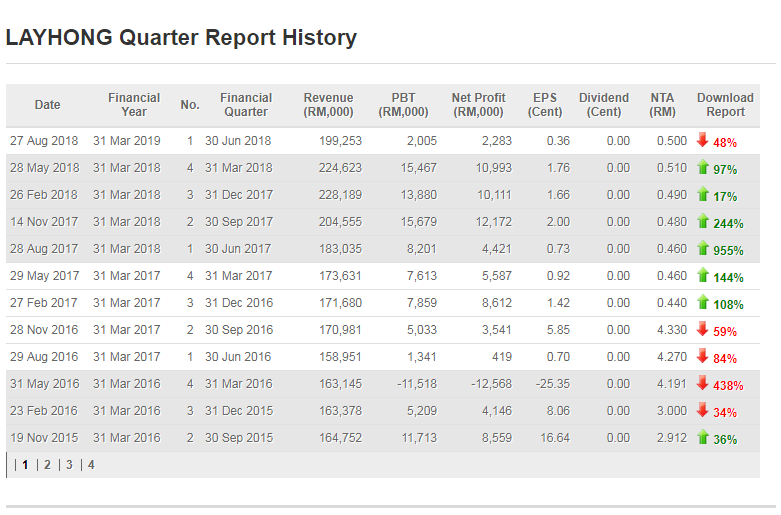
Example: LAYHONG QR for Financial Year 2019, with the first quarter ending on 30 June 2018. Looking at it, the first quarter was not as encouraging compared to the QR for Financial Year 2017.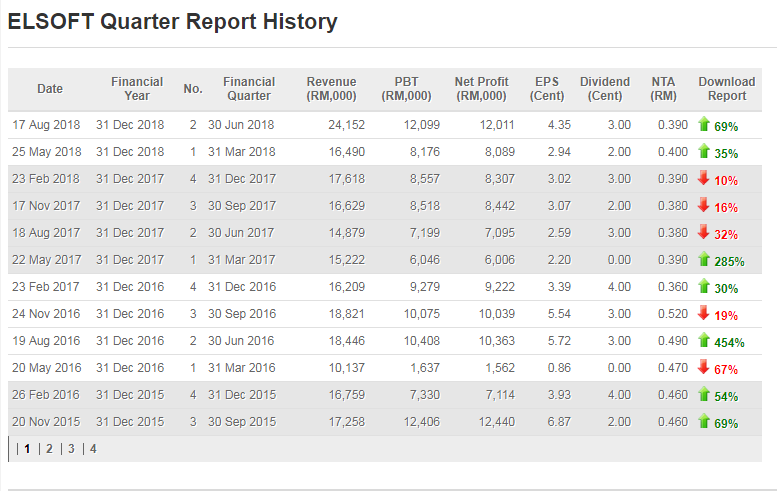
Another example is ELSOFT, which showed better QR for Financial Year 2018 across 2 quarters. From these QRs, we observe the quarter-over-quarter performance, looking for counters with consistently improving results and no declines. - REVENUE AND PROFIT TREND
Revenue refers to the sales achieved by the company. It depends on the company -- sales can come from products or services.
Besides the QR, we also need to examine the Revenue and Profit Trend in this fundamental analysis technique. The characteristic we look for is a chart that trends upward every year.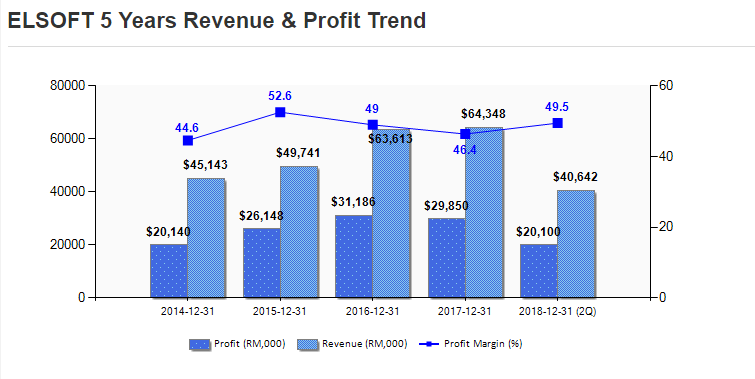
Example: ELSOFT -- looking from 2014 to 2015 it increased, then dipped slightly through 2017, and by 2018 (with only 2 quarters), it was already slightly higher than 2016. So 2018 might continue to increase. Quite interesting despite a slight decrease in 2016 and 2017. This proves the company remains competitive.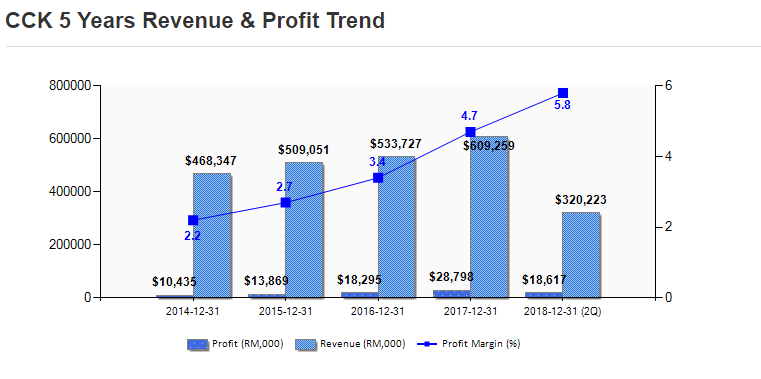
Another example is CCK (poultry counter) -- from 2014 through 2018, even with only 2 quarters reported in 2018, it kept increasing. Personally, I find counters like this appealing.
Financial Information
In the Financial Information section, there are several terms you absolutely must know. These include:
- ROE (Return on Equity)
Return on Equity is one of the key terms in this profitable fundamental analysis technique. The criterion we look for is an ROE greater than 10%. Even better if it exceeds 15%. For example, CCK has an ROE of 14.44%, while NESTLE, which has a much higher share price, has an ROE of 88.37%. - MARKET CAPITALISATION
For Market Cap, we look at companies with a market capitalisation ranging from RM300 million to RM1 billion.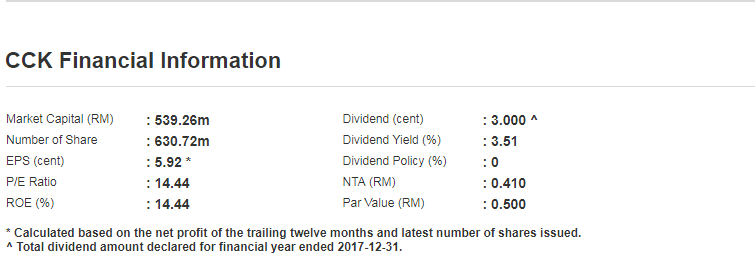
Example: The CCK counter meets the Financial Information criteria.
Tools for Fundamental Analysis
Many of you must be wondering how to conduct this research. This technique is very straightforward and does not require any powerful software. You only need to use malaysiastock.biz.
We can obtain all the information I have shared above from this website. Once you have gathered your research, try listing your findings. Then we can see the details clearly.
Here is an example of how to list your research. This is just an example of how to list -- it is NOT a buy call signal!
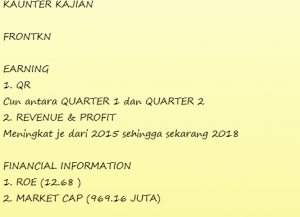
Once you have completed your listing, you will feel more confident. Then you will know exactly what decisions to make. Others will also recognise you as a knowledgeable investor.
Planning Your Trade

Once your research is complete, we move on to planning. Planning is about setting your goals.
How long do you intend to hold, and how much profit do you expect?
For example, you target an entry price of RM0.910 and plan to exit when it reaches RM1.00.
This is your primary objective!
So regardless of what happens, your focus is RM1.00!
You might reach this target price within 1 day, 7 days, or perhaps 2 weeks.
All of these scenarios are possible, but because you already have a plan, you do not need to worry. You must also set a cut-loss level.
During planning, you decide what kind of trader you want to be. Some prefer short-term, others mid-term, and some long-term.
It all depends on your temperament. If you cannot wait for a year, then you cannot be a long-term investor. Perhaps mid-term is more suitable for you.
Conclusion
Once you have completed everything I have discussed above, you will possess a piece of research that you can be confident in, and it will be immensely useful.
You will no longer need to follow anyone else's buy calls. The technique I have described focuses more on mid-term and long-term trading.
It may seem simple, but many people overlook this straightforward technique that could potentially deliver returns of more than 50% within 3 months.
Furthermore, this technique reduces the risk of losing your capital in the stock market, because you have conducted thorough research and only buy companies with strong fundamentals.
FAQ - Fundamental Analysis of Stocks
What is fundamental analysis of stocks?
Fundamental analysis is a method of studying the true value (intrinsic value) of a company based on financial data such as earnings, revenue, ROE, and market capitalisation. Its main objective is to find undervalued stocks to purchase at a discounted price.
What is the difference between fundamental and technical analysis?
Fundamental analysis evaluates a company's financial health and true value using financial reports, whereas technical analysis studies price movements and trading volume through charts. Both can be combined for more accurate investment decisions.
How do you find undervalued stocks on Bursa Malaysia?
Use websites such as malaysiastock.biz to check criteria like ROE exceeding 10%, increasing revenue and profit trends, and consistent quarterly reports. An undervalued stock has a market price below the company's intrinsic value.
How long does it take to profit through fundamental analysis?
Fundamental analysis is more suited for medium to long-term investing. The market may take weeks to years to reflect a company's true value, so patience and careful trade planning are essential.
Level Up Your Investment Knowledge
Successful investing starts with solid knowledge.
Investment Basics:
Download our free Stock Market Basics Ebook for a complete guide.
Open a CDS Account:
Ready to get started? Open a CDS Trading Account today.
Further reading: